
For martial artists around the world, the name Ip Man has become nearly inseparable from Wing Chun Kung Fu. His life has inspired blockbuster movies, documentaries, and generations of students searching for an effective and intelligent approach to self-defense.
Behind the cinematic fights was a real martial artist whose influence helped transform Wing Chun from a regional Chinese fighting system into an internationally recognized martial art.
Ip Man did not create Wing Chun. The history and traditions surrounding the system extend well before his lifetime. What he did accomplish, however, was enormously important: he became one of the most influential teachers in modern Wing Chun history, taught a generation of practitioners in Hong Kong, and helped establish a teaching legacy that eventually spread throughout the world.
One of his students would become particularly important. His name was Bruce Lee.
Understanding Ip Man’s story therefore means looking beyond the movies. It means exploring how a traditional Southern Chinese martial art survived periods of enormous social change and eventually became one of the most recognizable Kung Fu systems practiced today.

From Foshan to Hong Kong: The Story of Ip Man and Wing Chun
Ip Man, whose name is also commonly written as Yip Man, came from Foshan in Guangdong Province, a region of southern China famous for its martial arts traditions.
Accounts from within his family and Wing Chun lineage describe Ip Man beginning martial arts training while still a child. His early exposure to Wing Chun placed him within a fighting tradition that emphasized efficiency rather than unnecessary movement. That concept remains fundamental to Wing Chun.
Rather than attempting to overpower an opponent through strength alone, Wing Chun traditionally emphasizes positioning, structure, economy of motion, centerline control, simultaneous defense and attack, and the ability to function at extremely close distances. This can create a very different appearance from martial arts centered around wide movements, spectacular kicks, or long-range exchanges. When properly developed, movement has a purpose.
A block does not need to travel farther than necessary. A strike should move toward its target without unnecessary motion. Defensive actions can transition immediately into attacks, while sensitivity and positioning can help a practitioner recognize and respond to pressure.nThose ideas would eventually become closely associated with Ip Man’s teaching.
Ip Man’s life also unfolded during an extraordinarily turbulent period of Chinese history. After the Chinese Civil War and the establishment of the People’s Republic of China, Ip Man relocated to Hong Kong around the end of 1949. Accounts from his nephew and student Lo Man Kam describe him traveling from Canton through Macau before arriving in Hong Kong. There, Wing Chun entered a new chapter. Ip Man began teaching during the early 1950s. His first classes were reportedly small. Lo Man Kam recalled only five or six students attending one of the earliest classes and described an atmosphere in which students trained, ate, and discussed their Kung Fu together. That modest beginning would eventually have consequences far beyond Hong Kong.
As Ip Man continued teaching, his students began passing the system to others. Different instructors developed their own interpretations, training methods, emphases, and organizations. Instead of disappearing during a period of enormous cultural change, Wing Chun began expanding. And then a young teenager walked into Ip Man’s school.
Ip Man, Bruce Lee, and the Worldwide Growth of Wing Chun Kung Fu
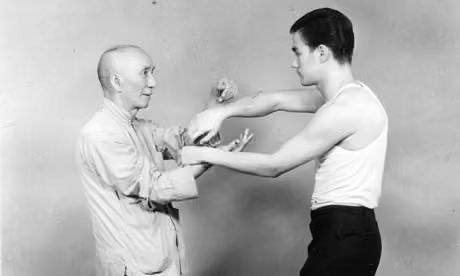
Bruce Lee began studying Wing Chun as a teenager in Hong Kong.
According to accounts from Ip Man’s family and students, Lee entered Ip Man’s school in the 1950s and became an enthusiastic student of the system. South China Morning Post records that Lee joined Ip Man’s Wing Chun classes as a teenager, while Ip Man’s son Ip Chun later recalled his father describing Bruce Lee as a particularly hard-working student. The relationship would ultimately connect two of the most recognizable names in martial arts history.
Bruce Lee eventually left Hong Kong for the United States. His martial arts philosophy continued evolving considerably after his Wing Chun training, eventually leading to the development of Jeet Kune Do and Lee’s broader ideas about martial arts. But Wing Chun remained an important part of his martial arts foundation. That connection proved incredibly important for Wing Chun’s international recognition. Bruce Lee became a global cultural phenomenon through television, demonstrations, teaching, writing, and eventually films such as The Big Boss, Fist of Fury, Way of the Dragon, and Enter the Dragon. As interest in Lee exploded, martial artists naturally wanted to know what he had studied. That trail led many of them back to Wing Chun and Ip Man.
Ip Chun later reflected that Bruce Lee helped make Wing Chun famous internationally after taking what he had learned to America.The worldwide growth of Wing Chun cannot be attributed to one person alone. Numerous students of Ip Man became respected teachers themselves, establishing schools and organizations that carried different branches of the system throughout Asia, Europe, Australia, and North America. Ip Man’s sons, Ip Chun and Ip Ching, also helped preserve and teach their father’s martial arts tradition after his death in 1972. Over time, Wing Chun developed into an international martial arts community containing numerous lineages and interpretations.
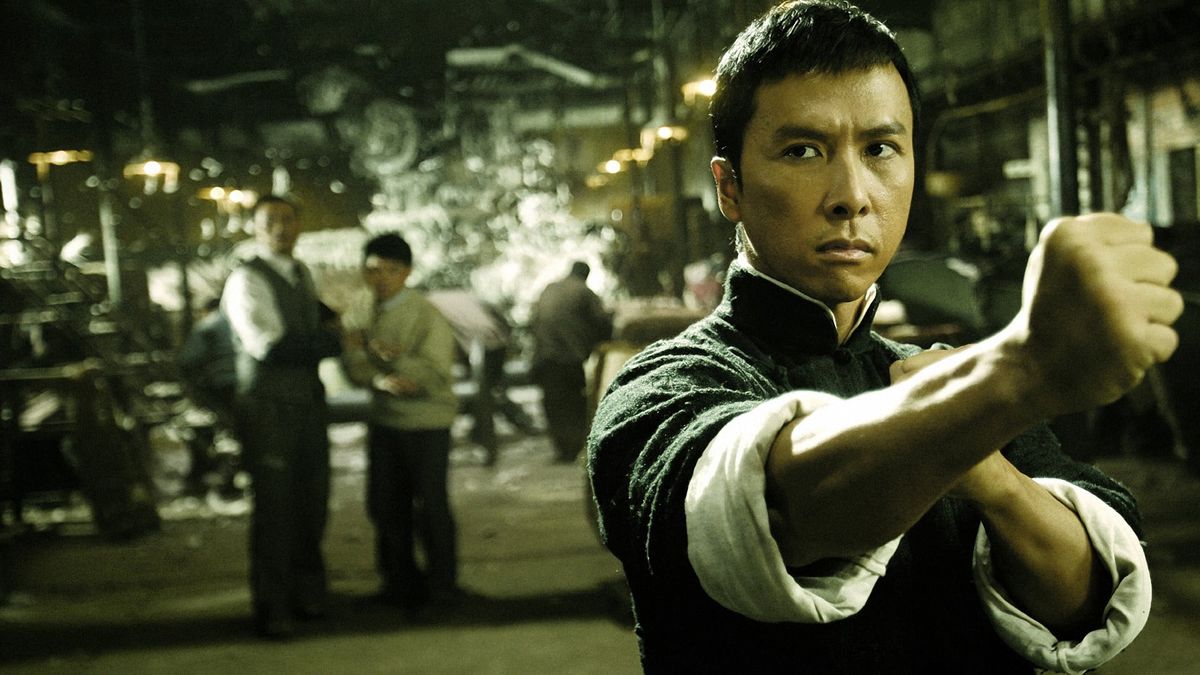
Then another unexpected event dramatically increased public interest. In 2008, actor and martial artist Donnie Yen portrayed Ip Man in the film Ip Man. The movie became enormously successful and helped introduce an entirely new generation to Wing Chun. However, anyone researching the history should recognize an important distinction: the movies are dramatizations rather than literal biographies. Even discussions of the films acknowledge that substantial portions of Ip Man’s early life were heavily fictionalized for cinema.
The real legacy may actually be more impressive. Ip Man did not need to defeat endless armies of opponents on screen to change martial arts history. He did it by teaching.
Why Ip Man’s Wing Chun Legacy Still Matters Today
More than half a century after Ip Man’s death, people throughout the world continue practicing Wing Chun Kung Fu. Part of its appeal comes from the unusual way the system approaches fighting. Many traditional Wing Chun methods emphasize close-range self-defense, efficient movement, balance, structure, timing, sensitivity, and the ability to attack while protecting yourself.
Training may include empty-hand forms, partner drills, striking practice, footwork, applications, Chi Sau or “sticking hands,” wooden dummy training, and other methods depending upon the instructor and lineage. But Wing Chun should not be understood simply as a collection of techniques.
The deeper goal is developing attributes. Students learn to recognize pressure. And perhaps most importantly, students discover that knowing a technique intellectually is very different from being able to perform it under pressure. That is where serious martial arts training becomes valuable.
Forms provide a foundation. Drills develop coordination. Partner exercises build timing and sensitivity. Increasing levels of resistance reveal whether technique can actually function against someone who is moving, reacting, and refusing to cooperate. That progression is one reason the quality of the instructor and training environment matters so much.
Wing Chun’s history contains numerous branches, teachers, and interpretations. A prospective student should therefore look beyond the name on the building and examine how the martial art is actually being taught.
Does the school explain the purpose behind its techniques?
Do students train with partners?
Are movements tested progressively?
Does the curriculum develop practical ability rather than simple memorization?
Does the instructor understand where the techniques succeed, where they fail, and how students should adapt?
Ip Man’s greatest contribution was therefore not simply becoming a famous martial artist. It was creating teachers. Those teachers created more teachers. Students crossed borders. New schools appeared. Different branches developed. Bruce Lee carried part of that influence to America, while generations of other instructors continued spreading Wing Chun throughout the world.
Today someone can walk into a Wing Chun school thousands of miles from Foshan or Hong Kong and begin learning concepts that have been passed from teacher to student across generations. That is an extraordinary legacy. Movies helped turn Ip Man into a cultural icon. Bruce Lee helped introduce Wing Chun to the world. But neither explains completely why the system survived.
Wing Chun survives because people continue stepping onto the training floor, placing their hands together with another student, testing structure, learning timing, making mistakes, and gradually understanding principles that cannot be learned simply by watching them.
For students interested in Wing Chun Kung Fu, practical self-defense, martial arts, and the history behind traditional Chinese fighting systems, Ip Man represents an important bridge between the old world and the modern one. His name may have become legendary.
His most lasting accomplishment, however, can still be found somewhere much simpler: in the Wing Chun being practiced and passed forward today.